



The story of the bird
Bright as new leaves and one of the first warblers of spring migration, the Yellow Warbler makes cheerful garden wall art for a sunroom, a kitchen or a hallway.
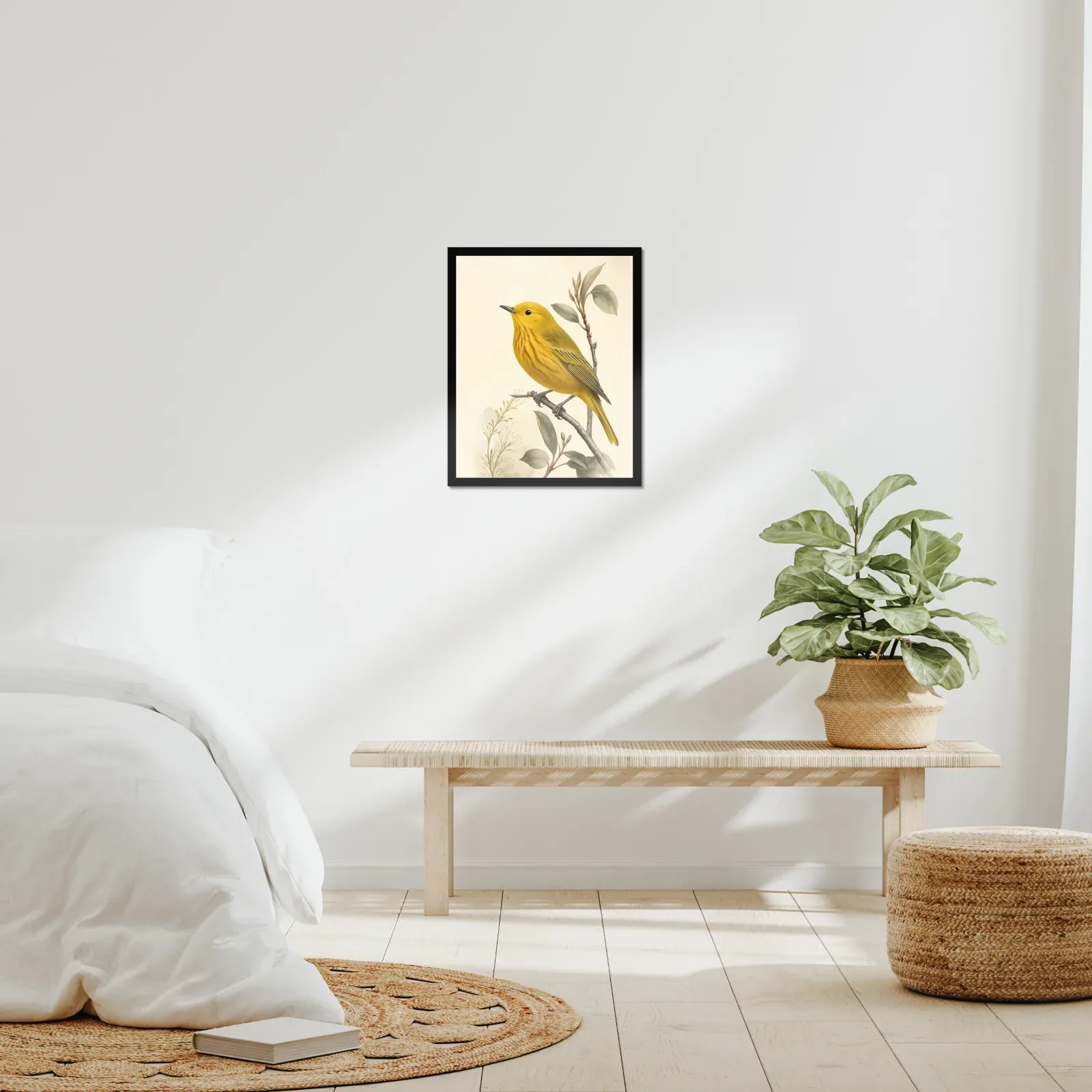
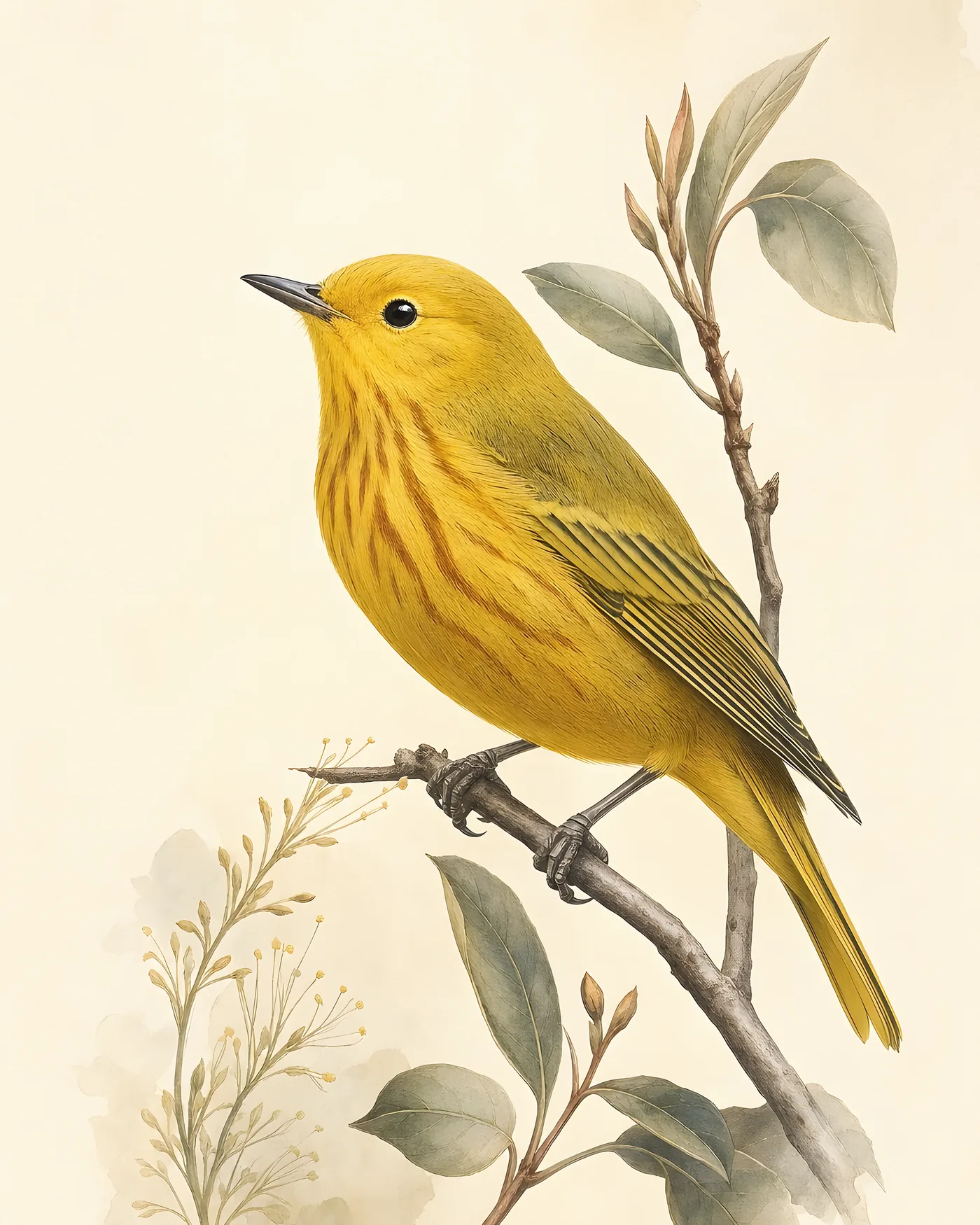
A male Yellow Warbler in full breeding colour, set on a willow stem. The plate holds him mid-work, the stem bending under almost nothing, his lemon-gold lit from the side against a cream ground and soft olive leaves. In life he is rarely this still.
Setophaga petechia is among the most widely distributed warblers in the Americas, breeding across almost all of North America, from Alaska south through Canada and the United States, with island and coastal forms reaching the Caribbean and the mangrove coasts of northern South America. For all that range, he is easy to miss. Tiny, around 10 to 18 centimetres, light enough to ride a swaying stem.
The fine chestnut streaks on his breast are the detail that separates the male from everything else. No other warbler wears them on that ground of uniform yellow. The female is softer, olive-yellow, often without the streaks, but both sexes carry yellow patches in the tail, a mark worth watching for when the bird flicks and turns in the willows.
He is a known target of the Brown-headed Cowbird, which lays its eggs in other birds’ nests. The Yellow Warbler’s answer is practical: he builds a fresh floor straight over the foreign egg and starts the clutch again. Researchers have found nests stacked several storeys high, each floor a response to an intruder.
A plate made in the tradition of Audubon, where the small birds of North America were given the same patient attention as the eagles.