



The story of the bird
The Snow Goose (Anser caerulescens) travels farther between its breeding and wintering grounds than almost any other North American waterfowl. Arctic tundra colonies, some containing more than a million birds, disperse south through the interior and Atlantic flyways in autumn - flocks so large they register on weather radar as solid precipitation returns.
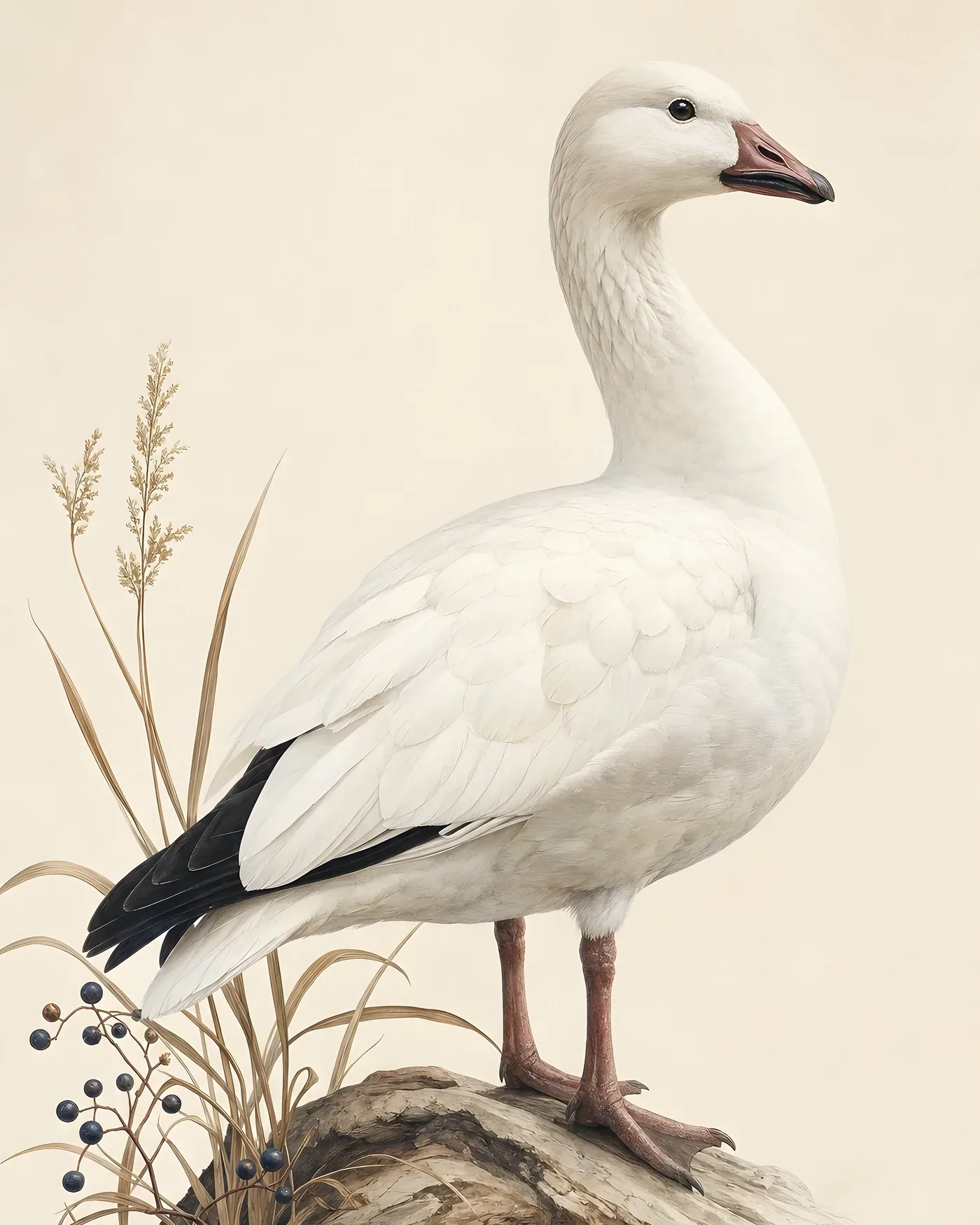
The white form is the one most people know: white plumage with black wingtips, a pink bill with a black grinning patch along the cutting edge, a pink-red leg. The dark morph - the Blue Goose - breeds in the same colonies and is the same species; the two forms interbreed. At stopover fields in the Mississippi valley and on the Atlantic coast, the flocks move across agricultural land in a rolling front, thousands of birds feeding and shifting simultaneously, the sound carrying across miles.
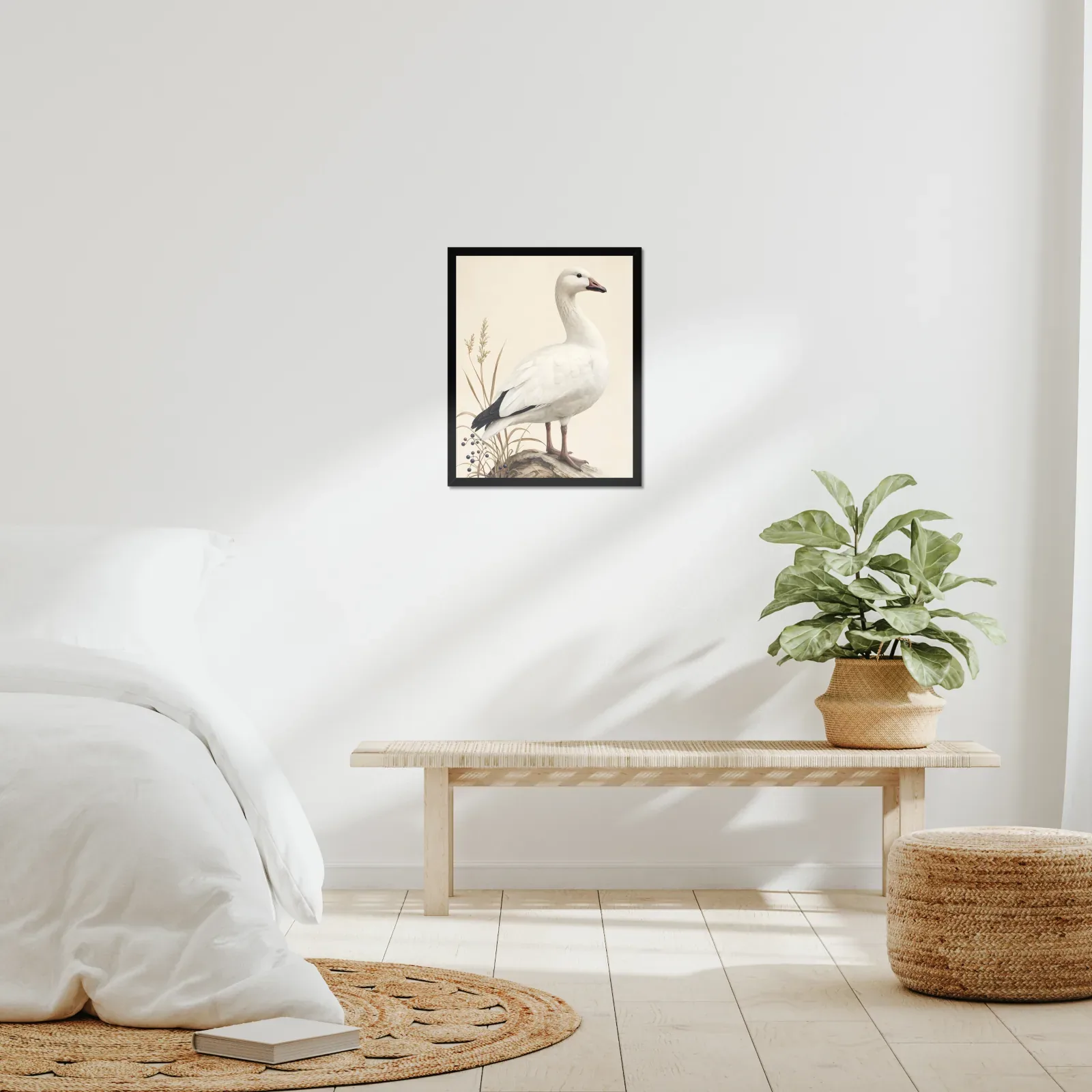
The plate shows the white-form bird in the upright alert posture: neck extended, the black wingtips just visible against folded white, the pink bill at full saturation, rendered in a contemporary Audubon-inspired natural-history style with a soft paper-grain finish. On a dark wall the white plate with a white subject creates a tonal study. On a pale wall the pink bill and the black tips are the only significant contrasts. Clean, elemental goose print for a lake house, a lodge or a coastal home.
Paper and finish
Unframed prints come on Hahnemuhle Photo Rag 308gsm, a heavyweight fine-art paper with a soft matte surface. The surface holds fine lines and subtle colour gradients without glare, which matters for Audubon-tradition work where the cream ground needs to read as paper, not as a white field. The framed option is set in a classic moulding, glazed and ready to hang, in black, white or natural.
Sizes
Three sizes: 8x10, 16x20 and 24x30 inches, or an instant digital download at $9. Prints from $39. Framed from $99.