




The story of the bird
The Great Tit (Parus major) is the most studied bird in Europe. Long-running research at Wytham Woods in Oxfordshire - where every nestling has been individually marked since 1947 - has made it one of the most genetically and behaviourally understood vertebrates on earth. What that research established is not a simple picture of a simple bird. Great Tit breeding timing, clutch size, and survival are individually variable in ways that track climate conditions across decades.
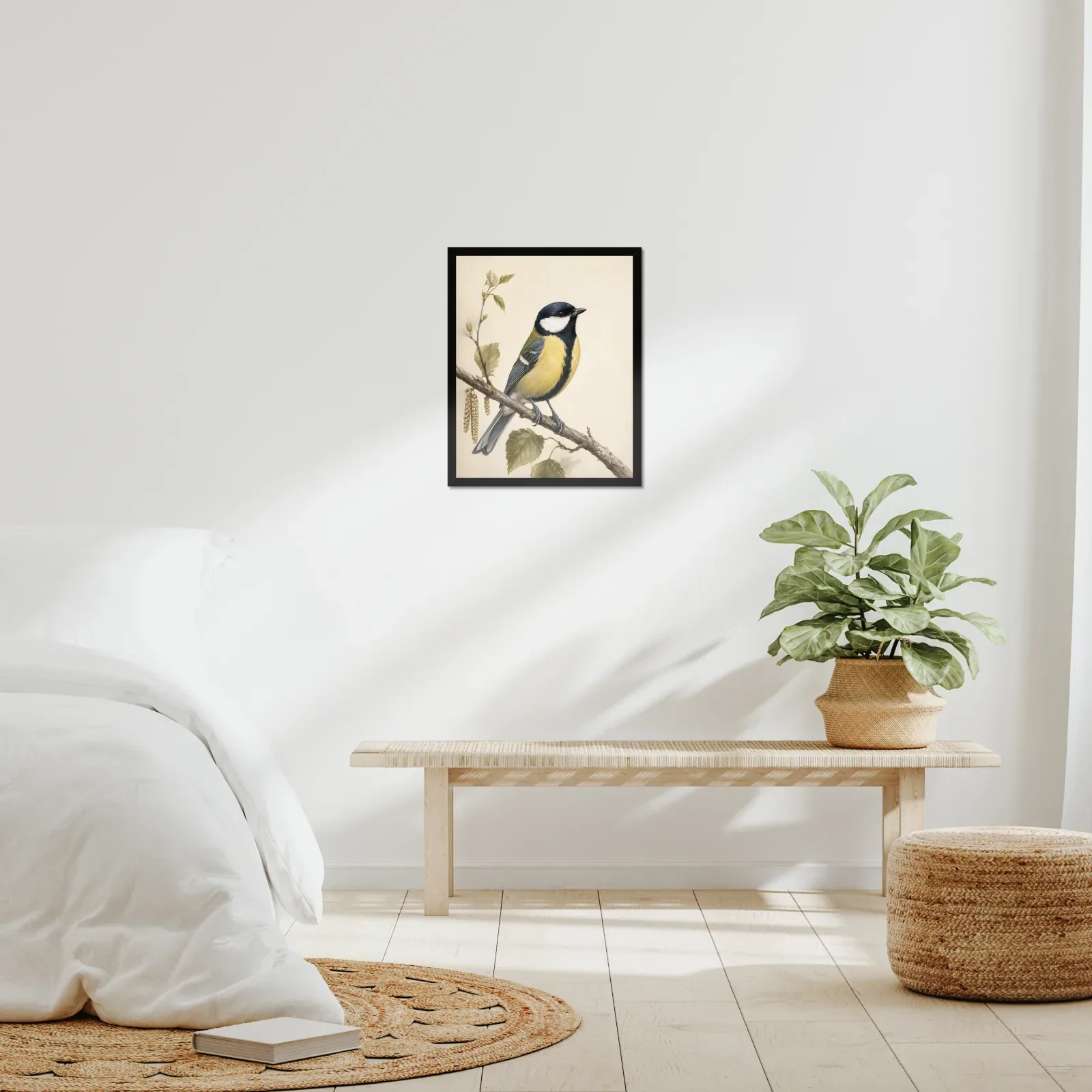
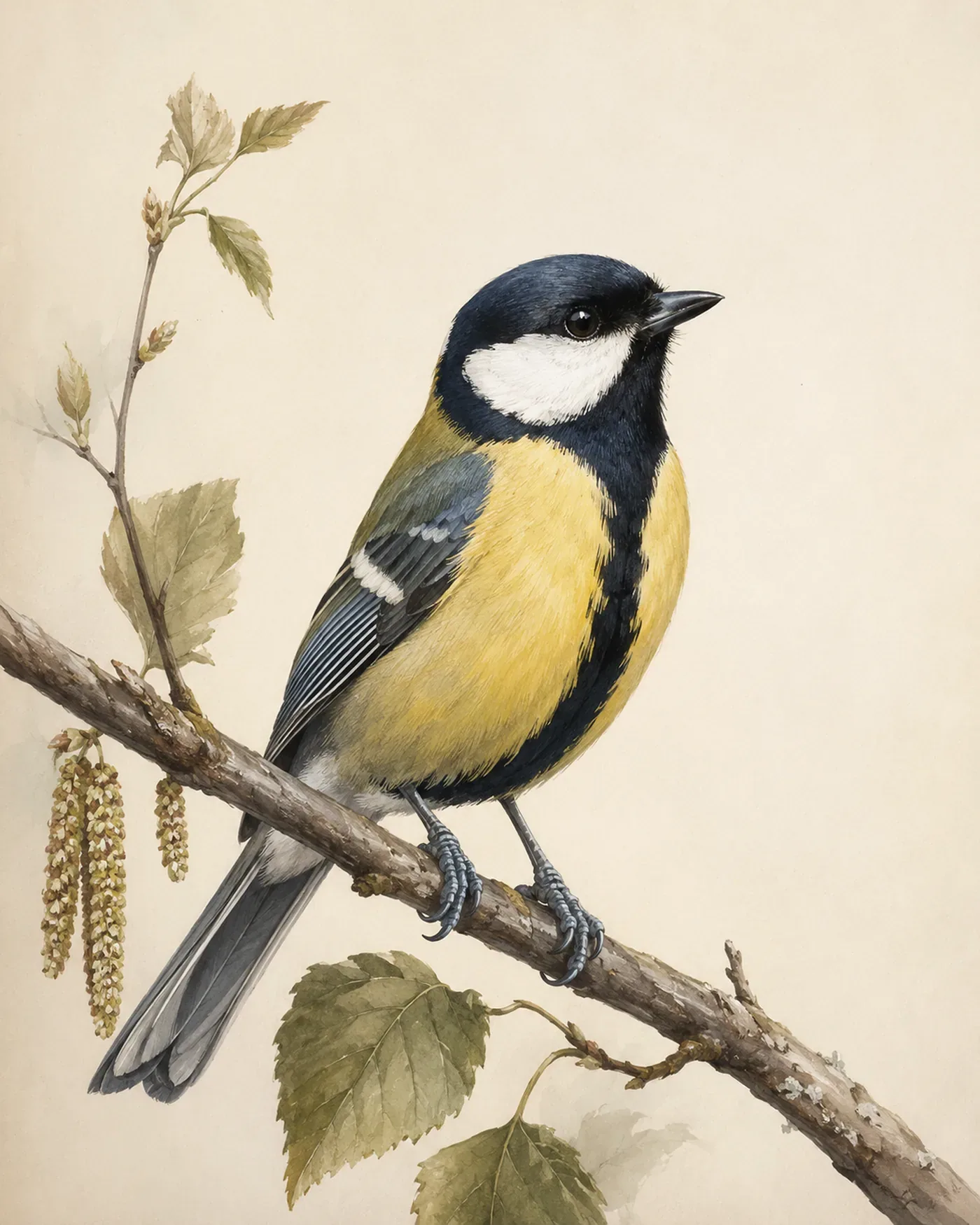
The field marks are straightforward: a glossy black head with white cheek patches, a yellow breast bisected by a central black stripe, a green back. The width of the central breast stripe varies with sex and condition - dominant males show the widest stripe. It is the most reliable quick-identification feature after the head pattern.
The Audubon plate shows the bird in the posture it favours on a suet cage: facing slightly downward, breast fully visible, the black head contrasting with white cheeks. The yellow and black of the breast read clearly at distance, which is why this is one of the first garden birds most people learn by sight.
Paper and finish
Unframed prints come on Hahnemuhle Photo Rag 308gsm, a heavyweight fine-art paper with a soft matte surface. The surface holds fine lines and subtle colour gradients without glare, which matters for Audubon-tradition work where the cream ground needs to read as paper, not as a white field. The framed option is set in a classic moulding, glazed and ready to hang, in black, white or natural.
Sizes
Three sizes: 8x10, 16x20 and 24x30 inches, or an instant digital download at $9. Prints from $39. Framed from $99.