



The story of the bird
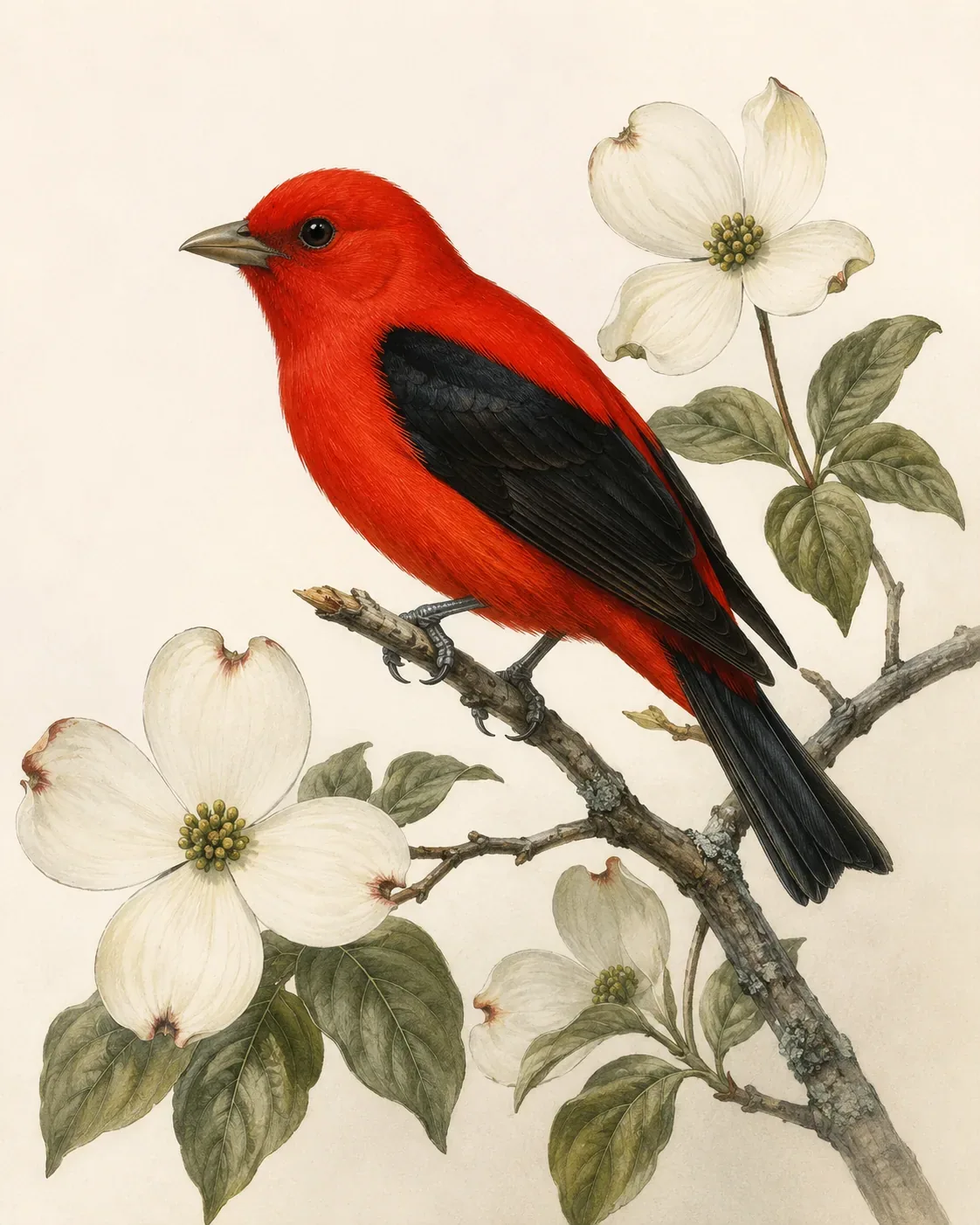
A Scarlet Tanager on flowering dogwood, in the Audubon tradition. A striking gift for a birder who loves spring colour, or a bold accent for a living room or study wall.
A flash of red among the dogwood blooms. The Scarlet Tanager perches on a flowering branch, his body a deep saturated scarlet, his wings and tail absolute black, the two colours with no other markings between them. The plate places him in that exact composition: cardinal red against the white flowers and sage green of the Audubon-style ground, a burst of colour set inside an otherwise quiet spring palette.
Piranga olivacea is described in the species literature as the most violent red in the eastern canopy. And yet it is reliably one of the hardest common birds to actually see. He sings from the crowns of tall oaks, sixty feet up, half-screened by new leaves, and the closed canopy swallows even that scarlet whole. Most people who know this bird know him first as a sound: a hurried, burry song, phrases that rise and fall - like an American Robin with a sore throat, the description goes, and it is exactly right.
The male’s two-colour design belongs only to the breeding season. Come autumn he moults into olive-yellow, keeping the black wings. He crosses to the South American tropics wearing colours close to the female’s, then returns the following May in full scarlet again. Partners in Flight estimates a global breeding population of around 2.6 million. The species requires large, unbroken tracts of mature deciduous forest, and its long-term vulnerability is tied directly to forest fragmentation, which brings Brown-headed Cowbird parasitism into nests that intact forest would shield.
In the tradition of Audubon, a glimpse of high-canopy colour, finally brought into reach.
Full field guide: /species/scarlet-tanager/